Jumat, 02 Desember 2022

Show HN: Recipe software for saving and searching recipes https://ift.tt/gUivSyr

Show HN: Recipe software for saving and searching recipes Made a LAN web-based recipe software with a database back-end that lets you save, search, and make meal plans with your recipes! Any suggestions are very welcome. I'm an independent publisher, posting this software. Right now my pricing model is to have a 2 week free trial before it asks for a serial code, which costs $7. https://ift.tt/O01ApZ9 December 2, 2022 at 06:13AM

Show HN: Programming Google Flutter with Clojure https://ift.tt/EQW9wo2

Show HN: Programming Google Flutter with Clojure This proof-of-concept project combines: - Flutter, from Google; - ClojureDart, port of Clojure to Dart from Tensegritics; and - Matrix, a reactive framework from moi. So, yes, we can now program Flutter with a Lisp. Yay. Project includes dozens of working examples and a full implementation of the TodoMVC classic to help tire-kickers play around. Support installing freely available on the #matrix channel on the Clojurians Slack. https://ift.tt/ujd8nEF December 2, 2022 at 01:41AM

Show HN: Py-obsidianmd, a Python library for Obsidian users https://ift.tt/I7ecKwE

Show HN: Py-obsidianmd, a Python library for Obsidian users Hello Hacker News, This message is relevant to those of you who use [Obsidian](https://obsidian.md/) for personal knowledge management. py-obsidianmd is a python library that enables you to change your notes’ metadata in batch. You can also easily move your metadata between the frontmatter and inline notation (dataview style). Checkout: - the presentation video: https://www.youtube.com/watch?v=gRPBAKiu37Y - github repository: https://ift.tt/tBukJ0z - example usage: https://ift.tt/4fou5WX It has saved me a lot of time, and made me free to experiment with how I handle my knowledge base’s metadata. I hope it can also be useful to others in the community ! Let me know if you have any feedback. Cheers, December 2, 2022 at 01:54AM

Show HN: The One Thing Well blog has resumed posting after a ~3y sabbatical https://ift.tt/ODqgUvA

Show HN: The One Thing Well blog has resumed posting after a ~3y sabbatical I'm not affiliated, just a fan. Some of my favorite CLI tools were discovered by reading this site. https://ift.tt/uO593nT December 2, 2022 at 12:41AM

Kamis, 01 Desember 2022

Show HN: We have built a benchmark platform for graph databases https://ift.tt/GlMgw8Z

Show HN: We have built a benchmark platform for graph databases https://ift.tt/xr47JaE December 1, 2022 at 03:34PM

Show HN: Notion Standup – Get daily reports on your tasks on Notion https://ift.tt/IFxRsDt

Show HN: Notion Standup – Get daily reports on your tasks on Notion Notion Standup helps you to receive daily standup reports on email and other channels for your and your team's current and overdue tasks on Notion. Stay updated always with daily reports through email, Slack, Discord, Webhook, Zapier, and Telegram. https://ift.tt/YO1V3SM December 1, 2022 at 08:40AM

Show HN: I am building a Safari Web Extension to switch tabs efficiently https://ift.tt/NWJL8gq

Show HN: I am building a Safari Web Extension to switch tabs efficiently I like the tab-switching behaviour in Chrome/Firefox and wanted Safari to have something similar. Another wish of mine was for it to be a web extension that feels native to the browser vs an app extension that looks out of place. After waiting long enough, I decided to build one myself. A little preview of Tap Tab - https://ift.tt/06m4ZcH . The web extension APIs for managing tabs are pretty locked down in Safari, but I have already found a lot of value in using the extension. Some of the features that I find very useful(in the middle of building a few of these) : - Driven by keyboard shortcuts. I can see the tabs I have open at a glance and switch between them. - Fuzzy search to quickly filter down to the tab you want. - Quick switching between two tabs. - Ability to pin, mute, and close the tab right from the extension. Say hello, and tell me what features you would like the extension to have!! You can follow the updates on Twitter- https://twitter.com/ManiBatra23 . https://ift.tt/9kY71bP December 1, 2022 at 08:55AM

A Brief History of the T Third Part 1: 1860-2007

A Brief History of the T Third Part 1: 1860-2007
By Jeremy Menzies

Earlier this month, we launched free weekend shuttle service in the Central Subway. And come January 7th, our 4 new stations will connect directly to the rest of the T line from Sunnydale to Chinatown. Through this two-part blog series, we will look back at some of the history of the T from the 1860s to today!

In Part One, we’ll look over the first 150 years from the 1860s to the 2000s. Next month in Part Two, we will take a closer look at the history of the T and Central Subway projects leading up to today’s service. 

The Horsecar Era: 1860s-1890s 

Starting in the 1860s, transit service along today’s T Line was provided by horsecars. These were small rail cars (that looked much like a cable car) that were pulled along tracks by horses. Two companies, the Omnibus Railroad and the North Beach & Mission Railway, operated horsecar lines on parts of the path of today’s T. These lines were mainly meant to connect North Beach with the 3rd and 4th street corridors as far south as about Townsend Street. 
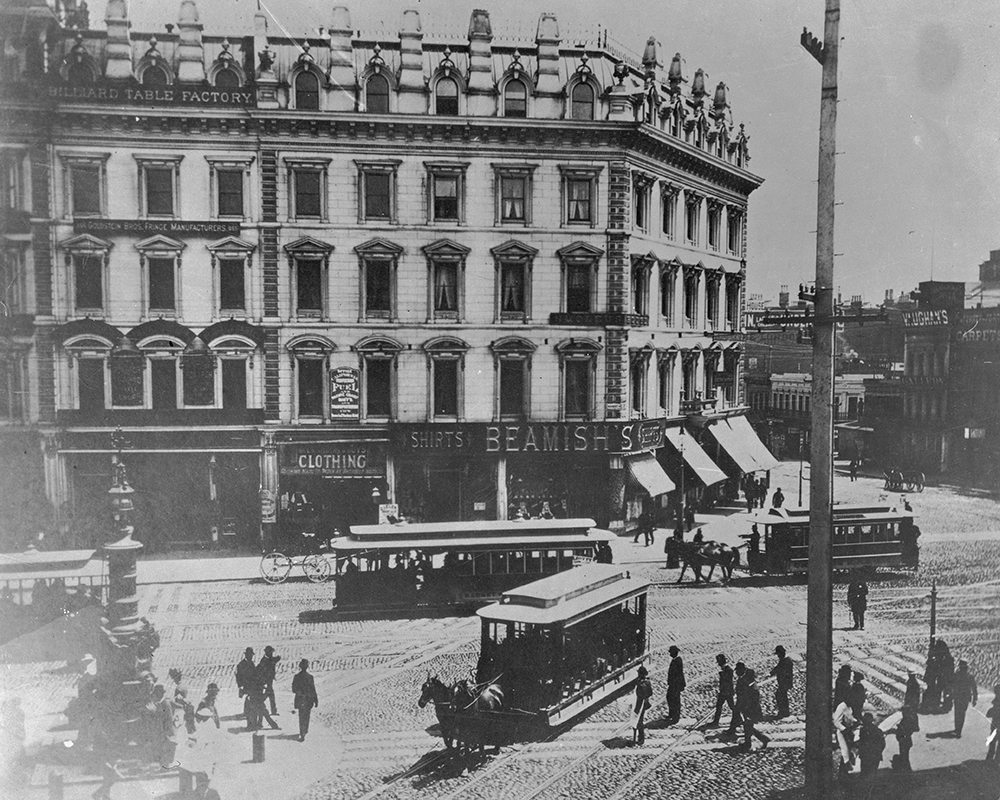
Image of a busy intersection from the 1890's with horse drawn streetcars, pedestrians and a department building are seen

This photo circa the 1880s shows the busy intersection of Kearny, Geary, 3rd and Market streets, looking south to 3rd.  In the foreground is a horsecar running up Kearny from 3rd. 

Further south on 3rd (then called Kentucky Street), horsecars were operated by the Potrero & Bay View Railroad. Here the route ran over two bridges across Mission Bay and Islais Creek (known as “Longbridge”), ending near today’s 3rd & Gilman. This route served the industrial heart of San Francisco and opened up development in the Bayview but was not very profitable because of its length. 

The Electric Streetcar Era: 1890s-1940s 

The 1890s marked the dawn of the electric streetcar era in San Francisco. A new technology, electric-powered cars could carry more people over longer distances faster than both horse and cable cars. On top of that, they were cheaper to operate and increased profit potential for transit companies. 
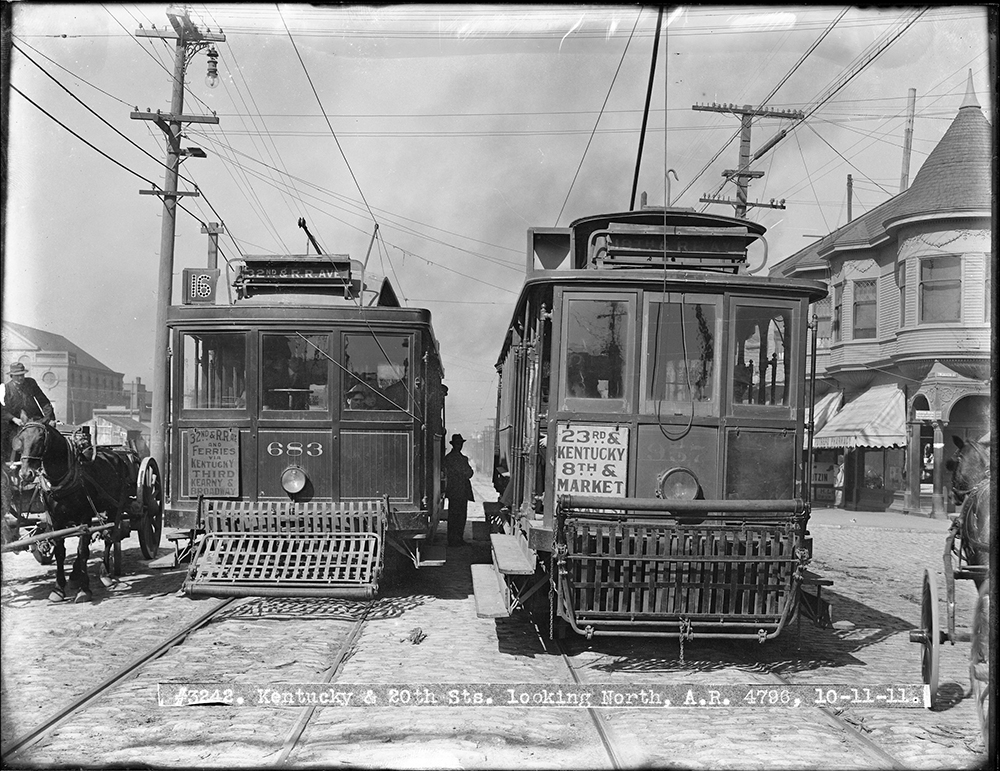
Two streetcars from 1911 shown with a person seen in the middle as well as a horse drawn carriage on the side

This 1911 photo shows two cars passing at 3rd (Kentucky) and 20th streets. On the left is a 16 Line car running to its terminal in the Bayview. At right is a 30 Line car heading north to 8th and Market. 

In 1894, the first electric streetcar line began operating along parts of today’s T Line. Known as the 3rd & Kearny Line, it followed much the same route as the early horsecars from North Beach to the Southern Pacific Railroad Depot on Townsend Street. It was extended into the Bayview to 3rd and Palou and eventually was reformed into the 15, 16, and 29 Lines. Each of these served a different portion of the corridor covering differing needs of riders travelling through downtown or all the way out to the Bayview. 
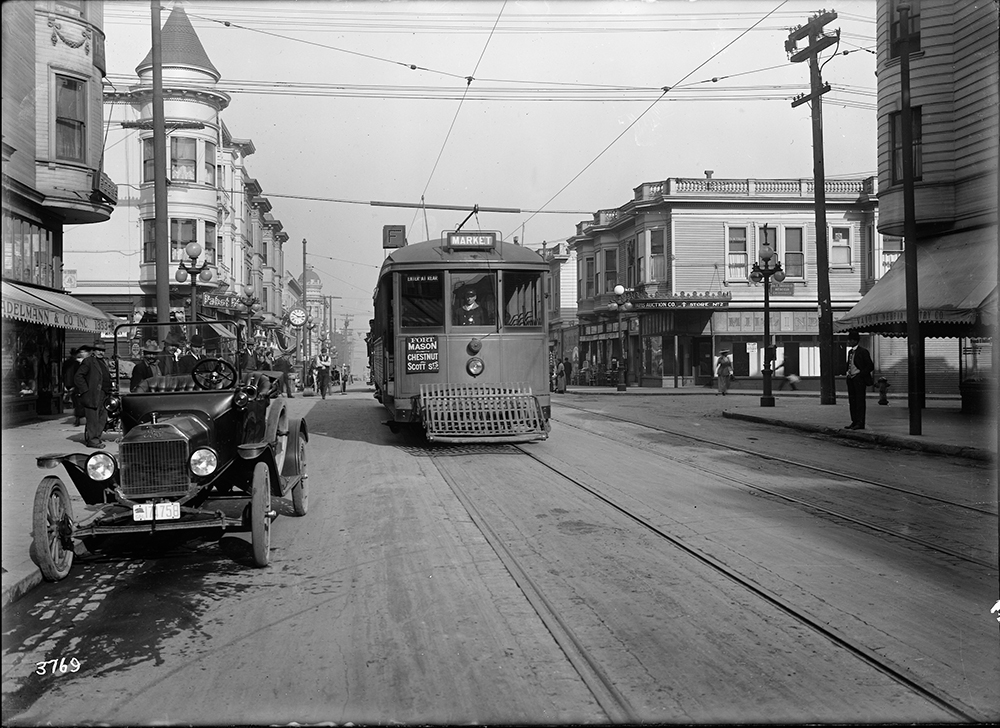
An old streetcar seen on the mainline with a few parked vehicles along the sidewalk and sundry stores in the background

A Muni F Stockton streetcar passes Vallejo Street in this photo from 1916. 

Muni’s first streetcar line to serve a similar route to the Central Subway portion of the T was the F Stockton, which opened for the 1915 Panama Pacific Exposition. The F Line ran along 4th and Stockton streets to serve South of Market, Union Square, Chinatown and North Beach before heading out to end at Chestnut and Scott streets. 

Buses along the Bay: 1950s-2000s 

Following World War II, the 3rd Street corridor was among the many that saw transit service shift from streetcars to buses. By 1951, the 15 Kearny route served much of the area once covered by the 15, 16, and 29 streetcar lines.  
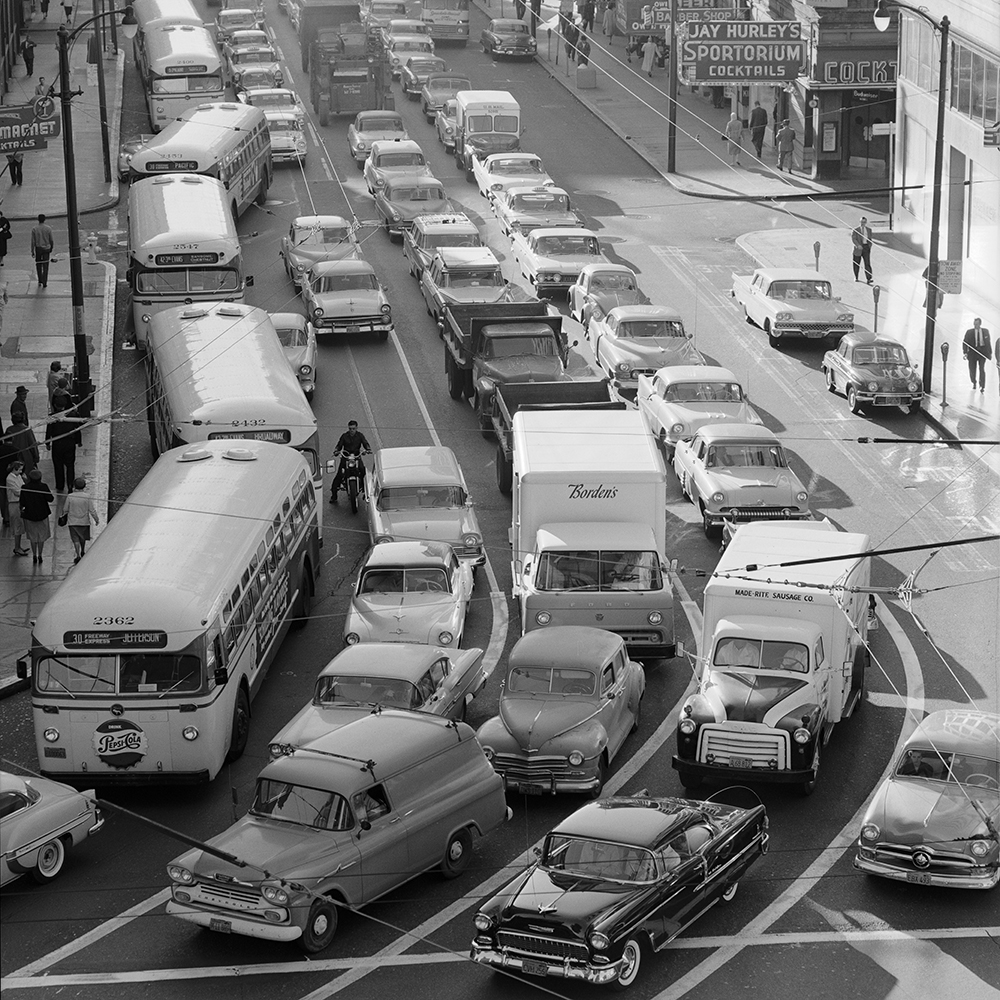
Cars and buses seen traveling during the busy commute on a congested street.

Buses on the 30, 15 and 42 fight the morning rush northbound on 3rd Street in this 1959 photo. 

Traveling along portions of today’s 8 Bayshore and T Third, the 15 route went from Powell and Jefferson streets all the way to Geneva and Mission. Eventually, it was extended to City College on Ocean Avenue. While not the only route to serve the area, the 15 carried the bulk of the load for people wishing to travel along this corridor. 

On Stockton Street, the 30 Stockton bus took over for the F, following the same route through Chinatown, Union Square, and South of Market to 4th and Townsend streets. 
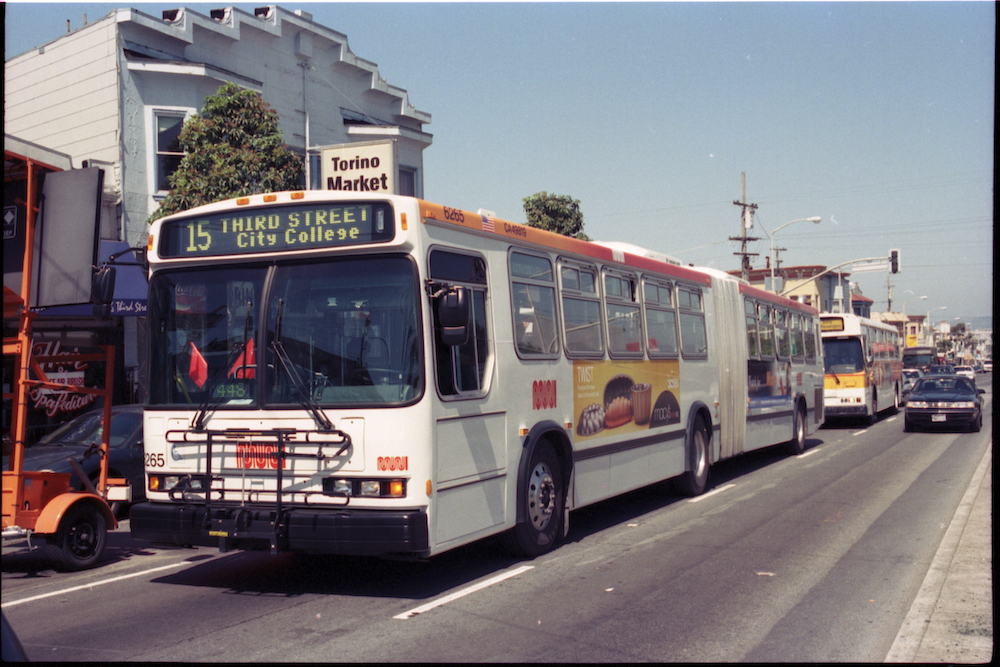
An articulated bus and coach seen traveling on a busy street

Many long-time riders will recognize this view of a 15 bus on 3rd & Palou. Discontinued with the opening of the T Line in 2007, the 15 was revived as the 15 Bayview-Hunter’s Point Express in 2021.  

Tune in next month for a closer look at the history of the T Third and Central Subway Projects. 


Published December 01, 2022 at 07:08AM
https://ift.tt/zgjxIU2

Show HN: AudioGata, a plugin based Web Audio player https://ift.tt/FTiLgJP

Show HN: AudioGata, a plugin based Web Audio player https://ift.tt/63KRUtq December 1, 2022 at 12:45AM

Show HN: Generate never-before-seen storyboards for Rick and Morty episodes https://ift.tt/Eg9mSLh

Show HN: Generate never-before-seen storyboards for Rick and Morty episodes Rick and Mortify is a system we built for creating never-before-seen episodes of Rick and Morty by leveraging the state-of-the-art in generative AI. These days generative AI is so hot right now. It promises to revolutionize all aspects of creative work from copywriting and image creation, to video and audio synthesis. Given the rapid progress of AI, when will we see an AI system listed in the closing credits of your favorite feature-length film? Rick and Mortify is a tool we built to demonstrate that future is closer than you might think. Our tool uses the state-of-the-art in large vision and language models to create never-before-seen episodes of Rick and Morty with minimal human intervention. All the plot points, dialogue, and accompanying visuals are generated with machine learning. Why use Rick and Morty as a case-study? Because 1) given the show's complex narrative structure and character profiles, it offers an ambitious north star for generative AI systems and 2) that show is the bomb and as AI researchers, we want to make Rick proud. Rick and Mortify is only scratching the service of what is possible and we're excited to see what you create with it. If you've been thinking about AI-driven story generation, we'd love to hear from you! https://ift.tt/drm2zOl November 30, 2022 at 11:37PM